How to Get ISO Certification in UAE
A step-by-step, UAE-specific explanation of the ISO certification process, requirements, cost factors and timelines — for business owners in Dubai, Abu Dhabi, Sharjah and across the Emirates.
If you run a business in the UAE and you’re trying to figure out how ISO certification actually works — who audits you, what it costs, how long it takes, and which standard applies to you — you’re not alone. Between certification bodies, consultants, accreditation marks and dozens of available ISO standards, the process looks more complicated from the outside than it needs to be. This guide walks through it in plain, practical terms for founders, compliance managers, contractors and exporters based in Dubai, Abu Dhabi, Sharjah, Ajman, Ras Al Khaimah, Fujairah and Umm Al Quwain.
Quick Answer
To get ISO certification in UAE, a business generally selects the appropriate ISO standard, defines its certification scope, implements the required management system with supporting documentation, and completes Stage 1 and Stage 2 audits with a suitable certification body. Any nonconformities are corrected before the certification body makes its decision and issues the certificate.
- What Is ISO Certification in the UAE?
- Why UAE Businesses Pursue It
- Step-by-Step Certification Process
- ISO Certification Requirements in UAE
- ISO Certification Cost in UAE
- How Long It Takes
- Common ISO Standards in the UAE
- Dubai, Abu Dhabi & Other Emirates
- Choosing a Certification Body
- Common Mistakes to Avoid
- ISO Certification Checklist
- Illustrative UAE Scenarios
- Why Work With JS Certification UAE
- Frequently Asked Questions
What Is ISO Certification in the UAE?
ISO certification in the UAE is formal, independent confirmation that an organization’s management system meets the requirements of a specific ISO standard — for example, ISO 9001 for quality management or ISO 27001 for information security. That confirmation is issued by a certification body after it audits your organization, not by ISO itself.
This distinction trips up a lot of first-time applicants, so it’s worth breaking down the four parties involved before going any further:
Key Takeaway
ISO writes the standards. A certification body audits your organization and issues the certificate. An accreditation body oversees and licenses certification bodies. An ISO consultant helps you prepare for the audit but does not certify you.
ISO (the standard-setter)
The International Organization for Standardization develops and publishes international standards — the documented requirements that define what a “quality management system” or “information security management system” should look like. ISO does not audit individual companies or hand out certificates directly; its role stops at writing and maintaining the standard.
An ISO standard
This is the actual document your organization implements against — for instance, ISO 9001:2015 or ISO/IEC 27001:2022. Each standard sets out clauses covering leadership commitment, planning, resource management, operational control, performance evaluation and continual improvement.
An ISO certification body
Also called a registrar, this is the independent third-party organization that audits your management system against the chosen standard and, if you meet the requirements, issues the ISO certificate. Certification bodies operating credibly in the UAE typically hold accreditation for the specific standards they certify.
An accreditation body
An accreditation body checks the competence and impartiality of certification bodies themselves. In the UAE, the Emirates International Accreditation Centre (EIAC) is the country’s national accreditation body and a member of the International Accreditation Forum (IAF), which is the global network that keeps accredited certificates mutually recognized across borders. Not every certification body operating in the market holds this kind of accreditation for every standard, which is exactly why it’s worth checking before you sign a contract.
An ISO consultant
A consultant — such as JS Certification UAE — helps you understand which standard fits your business, close the gap between your current processes and the standard’s requirements, build documentation, implement controls and prepare your team for the audit. A consultant coordinates with certification bodies on your behalf but does not issue the certificate; that decision always rests with the certification body.
Why Do UAE Businesses Pursue ISO Certification?
ISO certification is not a general legal requirement for every company registered in the UAE. It is, however, increasingly common as a business necessity rather than a purely voluntary nice-to-have, for a few concrete reasons:
- Tender and supplier prequalification: Many government entities, developers, contractors and large corporates in the UAE list ISO 9001 or other relevant standards as a supplier requirement for specific tenders and vendor panels.
- Customer and buyer expectations: International clients and B2B buyers, especially in manufacturing, logistics and export, often ask for evidence of a certified quality or safety system before signing contracts.
- Free zone and industry expectations: Certain free zones, industry associations and sector regulators treat relevant certification as a marker of operational maturity, even where it is not formally mandated by law.
- Operational improvement: Beyond external pressure, implementing a management system genuinely helps UAE SMEs standardize processes, reduce rework, manage risk and onboard staff more consistently.
Because requirements vary by sector, customer base and target contracts, it’s worth confirming exactly what your specific tenders, clients or regulators expect before assuming certification is — or isn’t — required for you.
How to Get ISO Certification in UAE: Step-by-Step Process
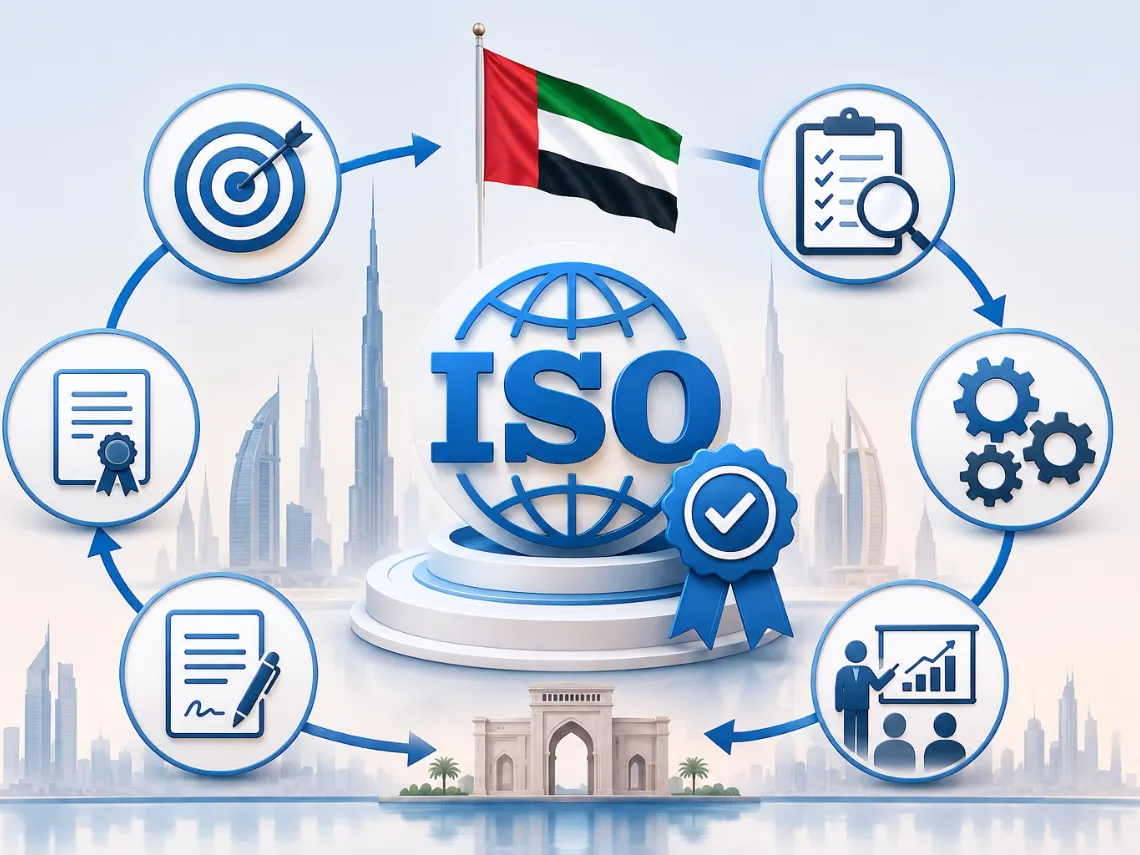
The exact sequence can flex slightly depending on the certification body and standard, but most UAE organizations move through the same nine stages.
Step 1
Choose the Right ISO Standard
Start with your business activity and what your customers, tenders or regulators actually ask for. ISO 9001 (quality) suits almost any business type; ISO 27001 (information security) fits IT and data-heavy businesses; ISO 45001 (health and safety) suits construction and industrial firms, and so on.
Step 2
Define the Certification Scope
Decide exactly which locations, departments, products or services the certificate will cover. A tightly defined scope (e.g., “design and installation of HVAC systems from our Dubai office”) keeps implementation focused and audit time predictable.
Step 3
Conduct a Gap Assessment
Compare your current processes against the chosen standard’s clauses to identify what already exists, what’s missing, and what needs to change. This step shapes your entire implementation timeline and budget.
Step 4
Develop and Implement the Management System
Build the policies, procedures, risk assessments and controls the standard requires, then put them into daily practice — this typically includes staff awareness sessions so employees actually follow the new processes, not just file them.
Step 5
Prepare Documentation and Records
Maintain evidence that the system is running: internal audit reports, corrective action logs, training records and management review minutes. Auditors look for proof of operation, not just written policy.
Step 6
Select an Appropriate Certification Body
Choose a certification body with relevant accreditation, scope coverage and industry experience for your standard (see the dedicated section below on how to evaluate options).
Step 7
Complete Stage 1 and Stage 2 Audits
Stage 1 reviews your documentation and audit readiness; Stage 2 is a detailed on-site (or remote, where permitted) assessment of whether the system is actually implemented and effective across your defined scope.
Step 8
Correct Nonconformities
If the audit identifies gaps — known as nonconformities — you’ll need to submit a corrective action plan and, in many cases, evidence that the issue has been fixed before certification can proceed.
Step 9
Certification Decision and Certificate Issuance
Once the certification body’s independent review confirms the audit findings meet the standard’s requirements, it issues the ISO certificate, typically valid for three years subject to ongoing surveillance audits.
Practical Tip
Certification doesn’t end at Step 9. Certified organizations undergo periodic surveillance audits — usually annually — and a full recertification audit before the three-year cycle ends. Treat ISO certification as an ongoing management commitment, not a one-time document.
What Are the ISO Certification Requirements in UAE?
There is no single fixed checklist that applies to every UAE business, because requirements depend on the ISO standard chosen, the organization’s scope, size, number of locations, industry and risk profile. That said, most management-system standards share a common backbone of expectations.
Summary
Common requirements across ISO management-system standards include a documented policy and objectives, defined roles and responsibilities, risk identification relevant to the standard, operational procedures, competence and awareness records, internal audits, a management review, and a corrective action process for handling nonconformities.
Examples of documentation and evidence that commonly come up during a UAE audit include:
- A policy statement (e.g., quality policy, information security policy, OH&S policy) approved by top management
- Process maps or procedures describing how core operations are carried out
- Risk assessments relevant to the standard (e.g., information security risk assessment for ISO 27001, hazard identification for ISO 45001)
- Records of internal audits and their findings
- Evidence of employee training and role-specific competence
- Minutes from management review meetings
- A corrective and preventive action log
Not every organization needs an identical set of documents — a five-person Dubai design studio pursuing ISO 9001 will look very different on paper from a multi-site Abu Dhabi manufacturer pursuing ISO 45001. What matters is that the documentation genuinely reflects how the business operates.
How Much Does ISO Certification Cost in UAE?
Quick Answer
There is no fixed, universal ISO certification price in the UAE. Cost depends on the ISO standard, company size, number of employees and locations, scope complexity, industry risk level, audit duration, the certification body chosen, and whether consultancy support is used. Businesses should request a scope-based quotation rather than relying on generic online figures.
Instead of quoting an arbitrary number that won’t reflect your actual situation, it’s more useful to understand what actually drives ISO certification cost in UAE up or down:
- ISO standard selected — some standards require more specialized auditor expertise (e.g., ISO 13485 for medical devices) than others.
- Company size and headcount — audit duration under IAF-aligned rules is generally linked to the number of employees within scope.
- Number of sites/locations — a business with operations across Dubai, Abu Dhabi and Sharjah will typically need more audit days than a single-location company.
- Scope complexity — a broad scope covering multiple services or product lines takes longer to audit than a narrow, well-defined one.
- Industry risk — construction, healthcare and food businesses often involve more detailed technical review than lower-risk service businesses.
- Certification body fees — different accredited bodies price audit days and travel differently.
- Consultancy/implementation support — gap assessment, documentation and internal audit support (if outsourced) is priced separately from the certification body’s audit fee.
- Surveillance and recertification — ongoing annual surveillance audits and the three-year recertification audit are recurring costs, not one-off.
Because certification fees and consultancy fees are two separate line items charged by two separate parties, ask for a transparent breakdown of both before committing, and treat “ISO certification cost in UAE” as a range determined by your actual scope rather than a single market price.
How Long Does ISO Certification Take in UAE?
Quick Answer
ISO certification timelines in the UAE vary from a few weeks to several months, depending on the organization’s readiness, the standard chosen, scope, number of locations, documentation maturity, and audit scheduling with the certification body. There is no single guaranteed timeframe that applies to every business.
Three factors generally shape how long the journey takes:
- Implementation readiness — how much of the required system (policies, records, controls) already exists versus needs to be built from scratch.
- Team training and internal audit maturity — how quickly staff can be brought up to speed on new procedures and how efficiently an internal audit can be completed.
- Audit scheduling and scope — the number of sites, shifts and employees in scope affects how many audit days the certification body needs, and when they have availability.
Be cautious of any provider promising a fixed, identical turnaround (such as a flat number of days) for every business regardless of scope — a genuine audit duration is tied to your organization’s size and complexity, not a marketing headline.
bus leo.
Which ISO Standards Are Commonly Used in the UAE?
The right standard depends entirely on your industry, customer requirements and risk profile — not every business needs every certification. Here’s a quick reference for the standards most frequently pursued by UAE organizations.
| Standard | Main Purpose | Suitable Businesses | Typical Business Benefit |
|---|---|---|---|
| ISO 9001 | Quality management systems | Almost any industry — manufacturing, services, trading, contracting | Consistent processes, fewer errors, tender eligibility |
| ISO 14001 | Environmental management | Manufacturing, construction, industrial and facilities businesses | Reduced environmental impact, sustainability credentials |
| ISO 45001 | Occupational health & safety | Construction, manufacturing, logistics, oil & gas | Fewer workplace incidents, safer site operations |
| ISO/IEC 27001 | Information security management | IT companies, SaaS, fintech, data-handling businesses | Stronger data protection, client trust for security-sensitive deals |
| ISO 13485 | Medical device quality management | Medical device manufacturers, distributors, healthcare suppliers | Regulatory alignment, market access for medical products |
ISO 9001 Certification in UAE
ISO 9001 is the most widely adopted management system standard among UAE businesses across nearly every sector, from trading and contracting to professional services. It focuses on consistent product/service quality, customer satisfaction and continual process improvement, and is frequently referenced as a baseline requirement in UAE tenders and supplier registrations.
ISO 14001 Certification in UAE
ISO 14001 helps organizations identify, control and reduce their environmental impact. It’s particularly relevant for manufacturers, construction firms and facilities management companies operating in the UAE, where sustainability expectations from developers, free zones and large clients continue to grow.
ISO 45001 Certification in UAE
ISO 45001 addresses occupational health and safety risk management. Construction, industrial and logistics businesses in the UAE commonly pursue it to formalize safety procedures, reduce incident rates and demonstrate a structured approach to worker protection on-site.
ISO 27001 Certification in UAE
ISO/IEC 27001 covers information security management — protecting data confidentiality, integrity and availability. UAE-based IT companies, fintechs and businesses handling sensitive customer data increasingly need it to satisfy enterprise clients and, in some cases, sector-specific data protection expectations.
ISO 13485 Certification in UAE
ISO 13485 is a quality management standard specific to medical devices. Manufacturers, importers and distributors of medical devices operating in or through the UAE use it to demonstrate that their quality processes meet the regulatory and safety expectations of the medical device sector.
ISO Certification in Dubai, Abu Dhabi and Other Emirates
ISO certification follows the same international framework regardless of which emirate your business operates from — the standards, audit stages and accreditation principles used for ISO certification in Dubai are the same ones applied in Abu Dhabi, Sharjah, Ajman, Ras Al Khaimah, Fujairah or Umm Al Quwain. What can differ from one emirate — or one industry — to another is which customers, developers, free zone authorities or tender bodies specifically request certification, and how quickly a local certification body or consultant can schedule an on-site audit.
Businesses with operations spread across multiple emirates should factor this into their scope definition early, since a multi-site certificate generally requires the certification body to sample or audit each relevant location rather than a single head office.
How to Choose an ISO Certification Body in UAE
Choosing the wrong certification body can mean a certificate that customers or tender authorities don’t recognize, or an audit experience that feels more like a paperwork transaction than a genuine assessment. Consider the following before signing an agreement:
- Accreditation: Confirm the certification body holds accreditation for the specific standard you need, ideally from a body recognized under the IAF Multilateral Recognition Arrangement, such as the UAE’s EIAC or another IAF member.
- Scope coverage: Check that the body is accredited for your specific industry sector code, not just the standard in general.
- Auditor competence: Ask about the auditor’s relevant industry background — an IT-focused auditor is better placed to assess an ISO 27001 audit than a generalist.
- Impartiality: A credible certification body should not also be the entity that wrote your documentation, to avoid a conflict of interest.
- Transparent audit process: Look for a clear explanation of Stage 1, Stage 2, surveillance and recertification timing and fees before you sign.
- Geographical coverage: If you operate across multiple emirates, confirm the body can audit all relevant sites within a reasonable timeframe.
- Certificate verifiability: A legitimate certification body should let you or your customers verify the certificate’s validity directly.
Expert Tip
The lowest quotation is not automatically the best option. An unusually cheap or unusually fast certification offer can be a sign of limited accreditation scope or a superficial audit — and a certificate that doesn’t hold up to customer or tender scrutiny can cost far more to fix later than it saved upfront.
Common Mistakes UAE Businesses Should Avoid
- Treating certification as a document, not a system. Auditors look for evidence the management system is actually running day-to-day, not just written on paper.
- Choosing a standard before understanding customer or tender requirements. Confirm what your target clients or tenders actually specify before committing budget to a particular standard.
- Skipping the gap assessment. Jumping straight to documentation without first identifying real gaps often leads to rework during the audit.
- Ignoring the certification body’s accreditation scope. A cheap certificate from a body without relevant accreditation may not be recognized by the customers or authorities that matter to you.
- Assuming certification is a one-time task. Forgetting about surveillance audits can result in a suspended or withdrawn certificate.
- Underestimating multi-site scope. Businesses spanning several emirates sometimes underestimate the audit time multiple locations require.
ISO Certification UAE Checklist
Use this as a practical starting point before you begin the certification journey:
- Identify the ISO standard(s) relevant to your industry, customers and tender requirements.
- Define the certification scope — locations, departments, products or services covered.
- Understand the standard’s core clauses and what evidence it expects.
- Run a gap assessment against your current processes.
- Prepare required documentation: policy, procedures, risk assessments, records.
- Implement controls and train relevant employees on new or updated processes.
- Conduct an internal audit and address any findings.
- Hold a management review meeting where applicable to the standard.
- Select a certification body with relevant accreditation and industry experience.
- Prepare your team for Stage 1 and Stage 2 external audits.
Illustrative UAE Scenarios
These hypothetical, illustrative examples show how the ISO route can differ by industry — they are not case studies of any specific client.
Illustrative Example
An Abu Dhabi manufacturing company supplying components to construction projects pursues ISO 9001 to meet a developer’s supplier prequalification requirement, focusing its scope on its production and quality-inspection processes.
Illustrative Example
A Dubai-based IT company handling client data for enterprise customers considers ISO/IEC 27001 after a prospective client’s procurement team asks for evidence of an information security management system before signing a contract.
Illustrative Example
A UAE construction contractor operating across multiple sites in Sharjah and Ajman evaluates ISO 45001 to formalize its site safety procedures and reduce workplace incident rates ahead of a large infrastructure tender.
Illustrative Example
A medical device distributor based in the UAE considers ISO 13485 to demonstrate its quality processes meet sector expectations as it expands its supplier relationships across the region.
Illustrative UAE Scenarios
JS Certification UAE operates as an ISO certification and compliance consultancy — meaning the team works alongside your business through discovery, gap assessment, documentation, implementation and internal audit preparation, then coordinates with an accredited certification body through to certification. As explained earlier in this guide, that consultant role is distinct from the certification body itself, which independently audits and issues the certificate.
Based on the services listed on the Management System Certifications page, JS Certification UAE supports a broad range of standards — including ISO 9001, ISO 14001, ISO 45001, ISO 22000, ISO 27001, ISO 13485, ISO 50001, ISO 20000-1, ISO 27701, ISO 42001, ISO 37001, ISO 22301, ISO 41001 and ISO 21001 — for businesses across Dubai, Abu Dhabi, Sharjah and the wider UAE. The team also offers IT security and compliance support (including GDPR, SOC, PCI DSS, HIPAA and VAPT), which can be relevant for businesses pairing ISO 27001 with broader data-security obligations.
You can learn more about the team’s approach on the About Us page, browse standard-specific guidance on the blog, or reach out directly through the Contact Us page for a scope-based quotation.
Add Your Heading Text Here
If you’re ready to work out which ISO standard fits your business and what your certification journey would actually involve, JS Certification UAE can walk through your scope with you. This does not guarantee a specific outcome, cost or timeline — every quotation is based on your actual business.